
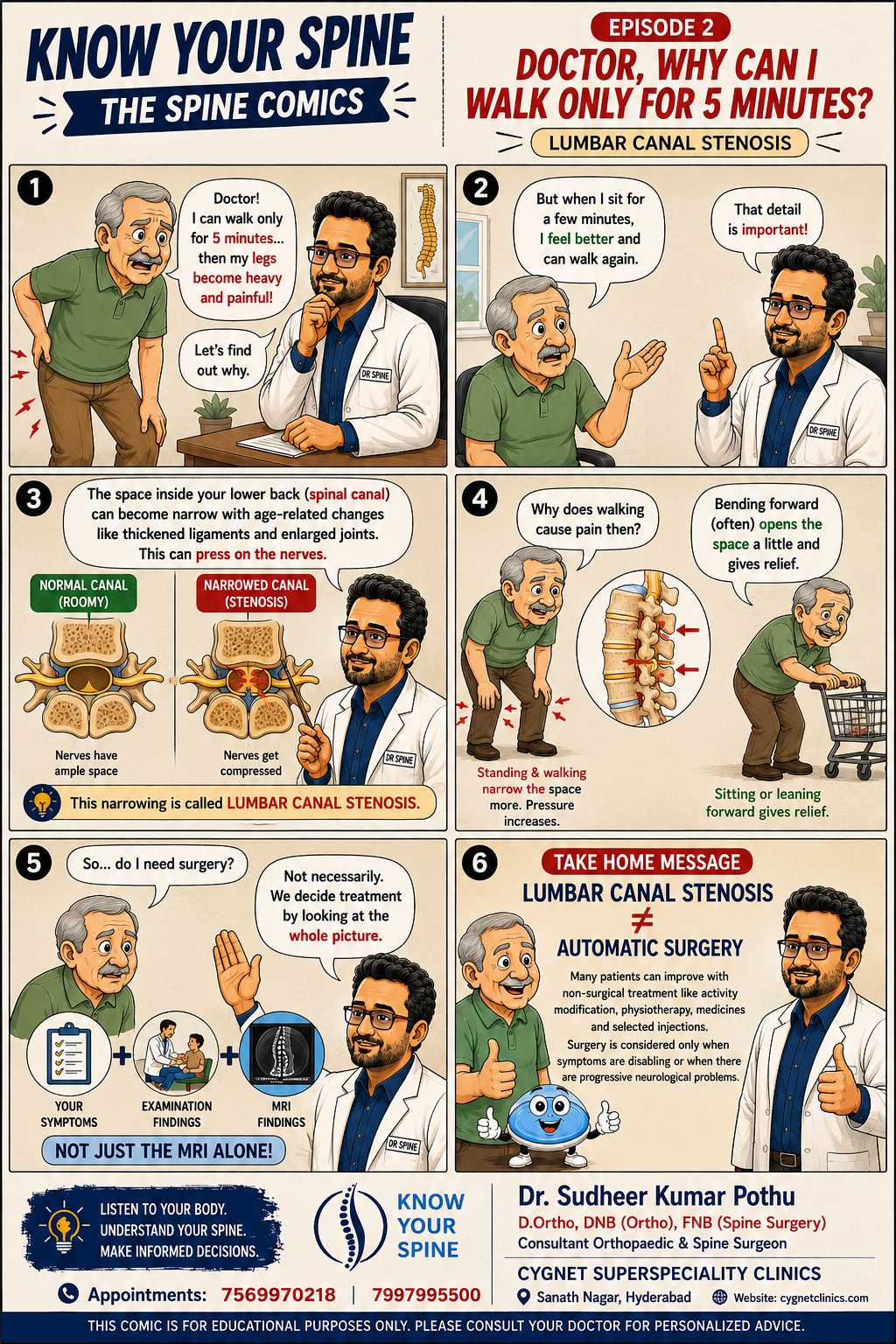
Why Can I Walk Only for 5 Minutes? | Lumbar Canal Stenosis | Spine Comics Episode 2
Do your legs become heavy or painful after walking for a few minutes—but improve when you sit or bend forward? This pattern can be an important clinical clue to lumbar canal stenosis, although similar symptoms can have other causes.
What is lumbar canal stenosis?
Lumbar canal stenosis is a narrowing of the spinal canal in the lower back. Age-related changes in the discs, ligaments and joints can reduce the space available for the nerves. When those nerves become compressed, symptoms may develop in one or both legs.
Why may walking cause symptoms?
Standing and walking—especially when the lower back is extended—can make the available canal space relatively smaller. This may increase pressure on the nerves and bring on leg pain, heaviness, numbness or weakness.
Sitting or bending forward may make the canal relatively roomier and reduce pressure on the nerves. Some people therefore find that they can walk farther while leaning on a shopping trolley or another support. Doctors sometimes call this the shopping-cart sign.
Typical symptom pattern
- Leg pain, heaviness, numbness or weakness during walking or standing
- Symptoms that develop or worsen with prolonged walking or standing
- Relief after sitting or bending forward
- Better walking tolerance while leaning on a trolley or other support
- Low-back pain may or may not accompany the leg symptoms
Diagnosis is not based on the MRI alone
An MRI can confirm narrowing and help plan treatment, but an MRI finding by itself does not determine what is causing a person’s symptoms. The diagnosis and treatment decision should bring together:
- Your symptoms and their effect on walking and daily life
- Neurological examination, gait assessment and other clinical findings
- MRI findings that match the symptoms and examination
Does lumbar canal stenosis always require surgery?
No. Lumbar canal stenosis does not automatically mean surgery. Depending on the clinical picture, many patients may improve with appropriately selected non-surgical care such as guided activity and exercise, physiotherapy, medication, lifestyle modification or selected injections.
Surgery may be considered when symptoms are severe or disabling, when adequate non-surgical treatment has not helped, or when there are progressive neurological problems.
When should you seek urgent medical assessment?
New bladder or bowel problems, numbness around the saddle or groin area, or progressive or significant weakness in the legs requires urgent medical assessment.
Take-home message: Symptoms, clinical examination and MRI findings must be considered together. Lumbar canal stenosis does not equal automatic surgery; treatment should be individualized.
Need a spine evaluation in Hyderabad?
Dr. Sudheer Kumar Pothu
D.Ortho, DNB (Ortho), FNB (Spine Surgery)
Consultant Orthopaedic & Spine Surgeon
Cygnet Superspeciality Clinics
Sanath Nagar, Hyderabad
Appointments: 7569970218 | 7997995500
cygnetclinics.com
This article is for general educational purposes and does not replace an individual medical consultation. Treatment recommendations require clinical evaluation.
