
TLIF Spine Surgery: Top 5 Key Facts for Patients
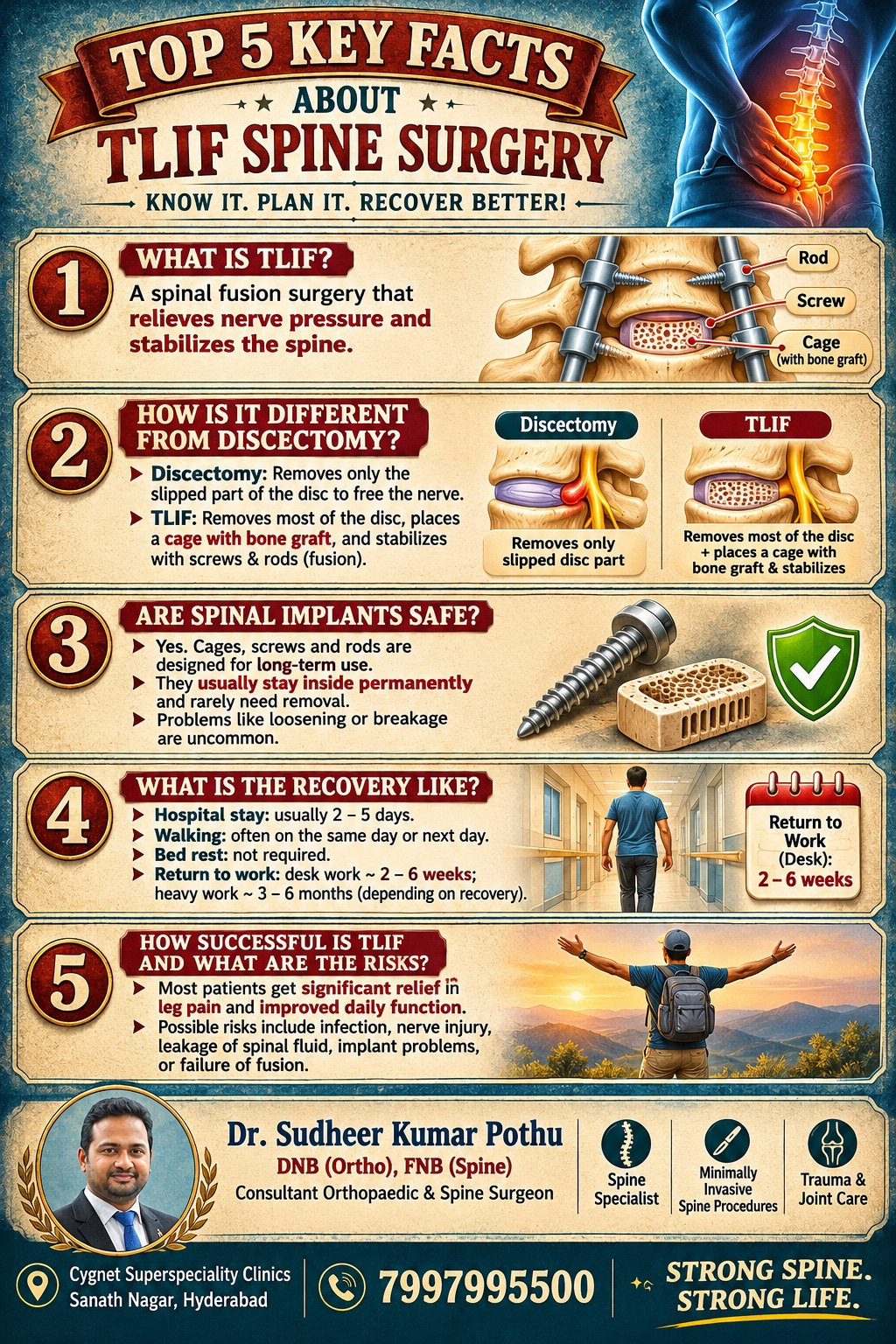
Hearing that you may need spine surgery can feel frightening. Will you walk normally? Will the screws stay inside? How long before you return to work? Understanding the operation can make these conversations easier. This guide explains five important facts about TLIF, a lower back fusion procedure, and what patients should discuss with their spine surgeon.
1. What is TLIF?
TLIF stands for Transforaminal Lumbar Interbody Fusion. In simple language, the surgeon approaches the disc space from the back, slightly to one side, relieves pressure on affected nerves, and joins neighbouring spinal bones. A small spacer, called a cage, holds bone graft between the bones. Screws and rods support the area while the graft gradually forms a solid bony bridge.
It may be considered when nerve compression occurs with spinal instability, such as certain slipped vertebrae, or in selected other conditions. An MRI finding alone does not decide treatment. Symptoms, examination, imaging and the effect on daily life must match. Many patients improve with medicines, suitable exercise, physiotherapy or injections and never need fusion.
2. How is it different from discectomy?
A discectomy removes the disc fragment pressing on a nerve. It usually preserves movement at that spinal level and does not require fusion. TLIF removes disc material to prepare the space for a cage and bone graft, while also stabilising the segment.
A simple slipped disc does not automatically require screws or fusion. The key question is whether nerve decompression alone is sufficient or whether stability also needs treatment. Ask your surgeon why TLIF is recommended for your particular problem and what alternatives are reasonable.
3. Are the implants safe?
Spinal cages, screws and rods are designed for long term use and usually remain inside permanently. Routine removal is generally unnecessary. They provide support; the bone graft must still heal. Implant loosening, breakage, movement or infection can occur, especially if fusion fails or bone quality is poor. Your surgeon may assess osteoporosis, diabetes control, nutrition and tobacco use to reduce avoidable risks.
4. What does recovery involve?
Many patients begin assisted walking on the day of surgery or the next day, when medically safe. Hospital stay is often around two to five days, although more complex surgery or other illnesses can extend this. Prolonged bed rest is usually discouraged; short, frequent walks and a gradual increase in activity are commonly advised.
Some patients resume light desk duties within two to six weeks; others need longer. Heavy work may require three to six months or more. These are planning ranges, not promises. Bone healing continues for months. Follow individual advice about lifting, bending, driving, wound care and physiotherapy, and attend scheduled reviews before increasing activity.
5. What benefits and risks should you understand?
In appropriately selected patients, TLIF can reduce nerve related leg pain and improve function. Back pain relief is less predictable, and longstanding numbness or weakness may not completely recover. Risks include infection, bleeding, blood clots, nerve injury, spinal fluid leakage, implant problems, failure of fusion and future problems at neighbouring levels. Occasionally further surgery is needed.
Seek urgent medical attention for new leg weakness, loss of bladder or bowel control, numbness around the groin, chest pain or breathlessness. Report fever or wound discharge promptly.
Before deciding, ask which symptoms surgery is expected to improve, how many levels need treatment, and what help you will need at home. A clear plan and realistic expectations help you participate confidently in your recovery and follow-up.
For an individual assessment, consult Dr. Sudheer Kumar Pothu, Consultant Orthopaedic & Spine Surgeon, at Cygnet Superspeciality Clinics, Sanath Nagar, Hyderabad. Bring your scans and questions.
