
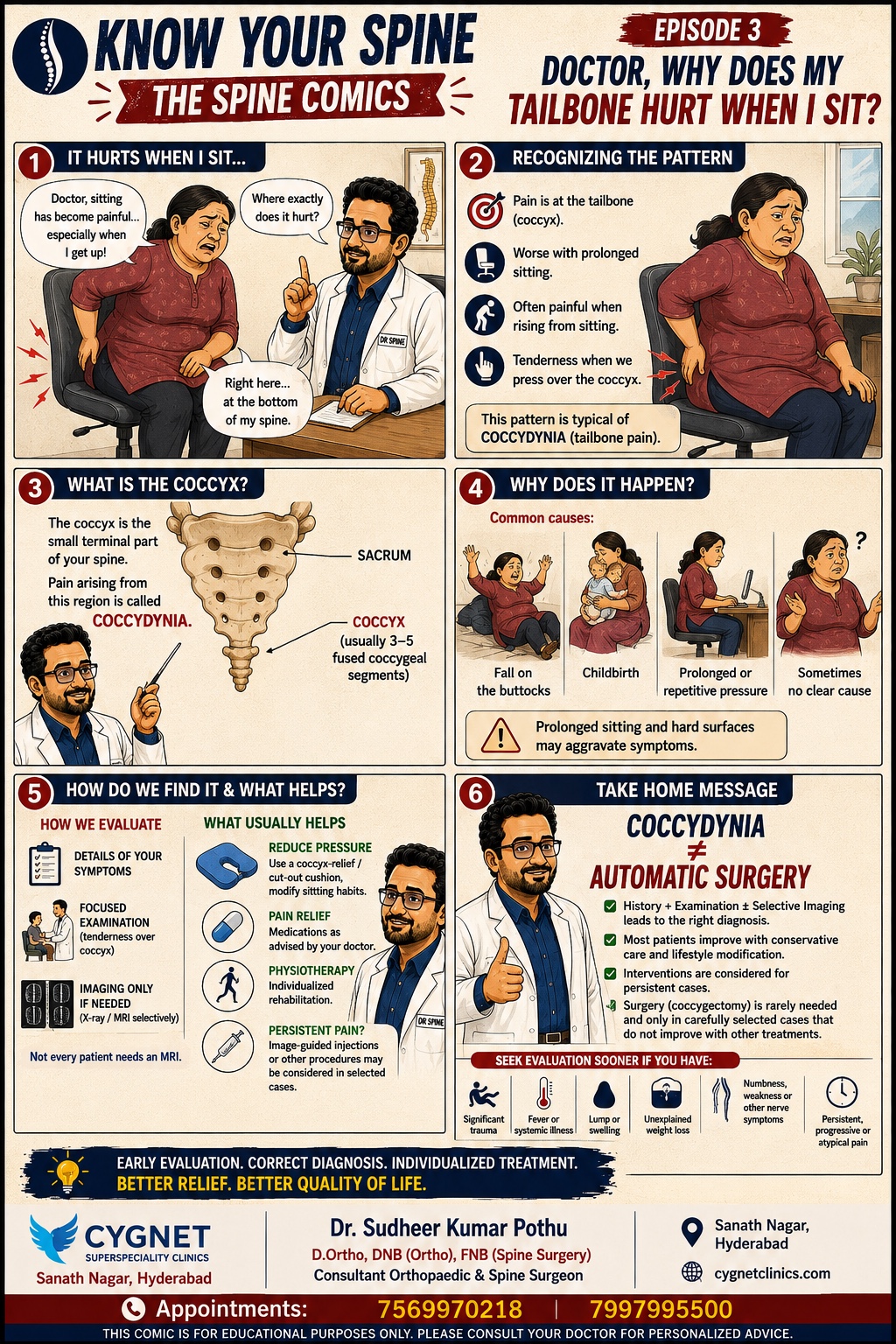
Doctor, Why Does My Tailbone Hurt When I Sit? – Coccydynia | Spine Comics Episode 3
Tailbone pain—also called coccydynia—often becomes noticeable while sitting, especially on hard surfaces or for long periods. It may also hurt when rising from a chair or when pressure is applied directly over the coccyx.
What is the coccyx?
The coccyx is the small terminal part of the spine, situated below the sacrum. Pain arising from this region is called coccydynia.

Why does tailbone pain happen?
Common causes include:
- A fall directly onto the buttocks
- Childbirth
- Prolonged sitting or repeated pressure on the coccyx
- Sitting on hard surfaces
Sometimes, no definite cause is found. A focused history and examination are therefore more useful than assuming every patient needs a scan.

How is coccydynia evaluated?
Evaluation usually begins with details of the symptoms and a focused examination for tenderness over the coccyx. X-rays or MRI may be advised selectively when the clinical findings or symptoms warrant them. Not every patient needs an MRI.
What usually helps?
Most patients improve with conservative care and lifestyle modification. Treatment may include:
- Reducing pressure with a coccyx-relief or cut-out cushion and modifying sitting habits
- Pain-relieving medication as advised by your doctor
- Individualised physiotherapy and rehabilitation
- Image-guided injections or other procedures for selected patients with persistent pain
Surgery to remove the coccyx—coccygectomy—is rarely needed and is considered only in carefully selected cases that do not improve with other treatments.

Take-home message: Coccydynia does not mean automatic surgery. The right diagnosis comes from your history and examination, with selective imaging when required. Most patients improve with conservative care.
When should you seek evaluation sooner?
Arrange an early medical assessment if tailbone pain follows significant trauma or is accompanied by fever or systemic illness, a lump or swelling, unexplained weight loss, numbness, weakness or other nerve symptoms, or persistent, progressive or atypical pain.
Need a spine evaluation in Hyderabad?
Dr. Sudheer Kumar Pothu
D.Ortho, DNB (Ortho), FNB (Spine Surgery)
Consultant Orthopaedic & Spine Surgeon
Cygnet Superspeciality Clinics
Sanath Nagar, Hyderabad
Appointments: 7569970218 | 7997995500
cygnetclinics.com
This article is for general educational purposes and does not replace an individual medical consultation. Treatment recommendations require clinical evaluation.
