
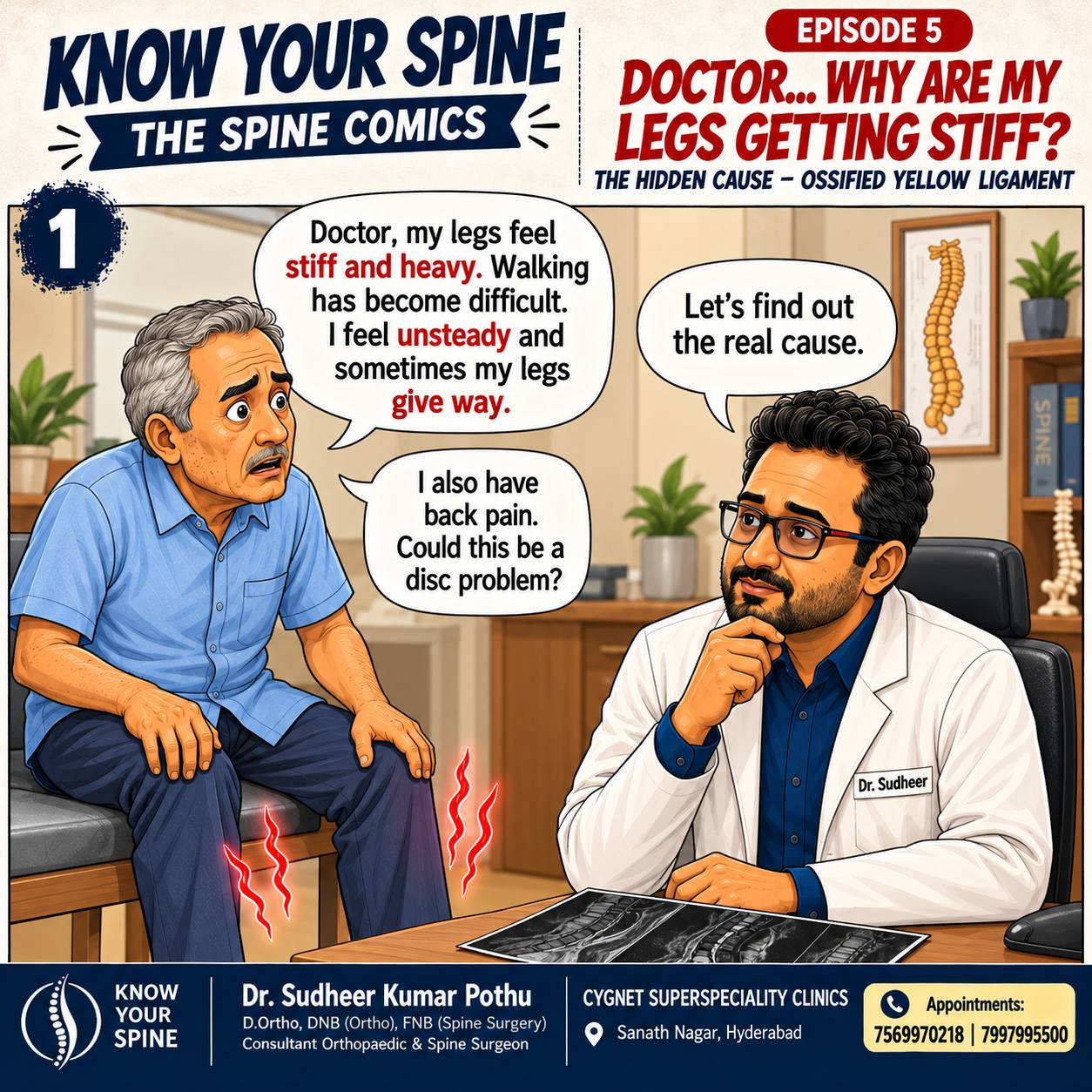
Ossified Yellow Ligament (OYL): When Spine Symptoms Are Not a Slipped Disc
When someone develops back pain, numbness in the legs, weakness or difficulty walking, the first explanation they often hear is: “It may be a slipped disc.”
Disc prolapse is common, but not every spine problem is caused by a disc prolapse. The spine also contains bones, joints, ligaments, nerves and the spinal cord. A problem affecting any of these structures can cause symptoms that look similar at first.
What is Ossified Yellow Ligament (OYL/OLF)?
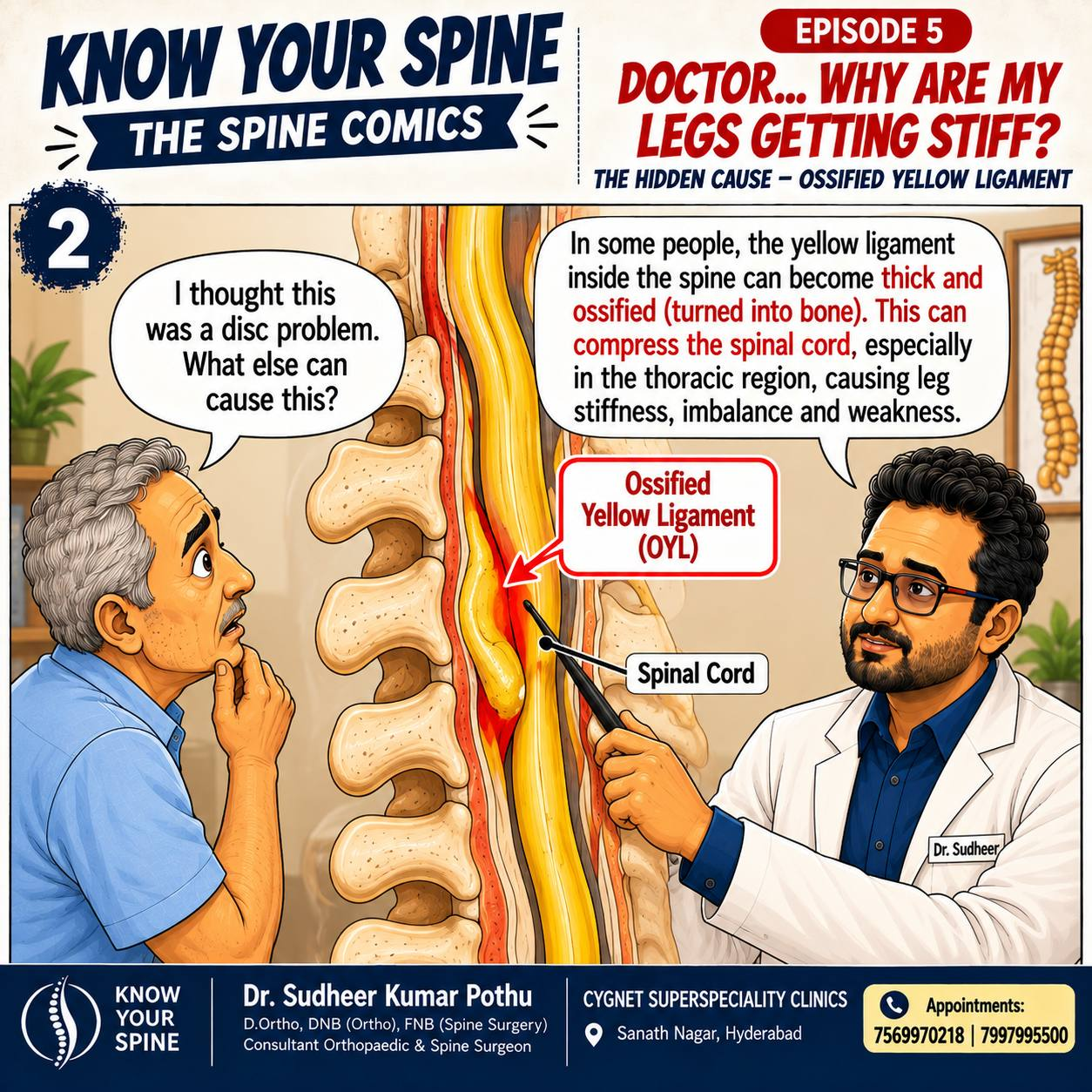
The ligamentum flavum, often called the yellow ligament, is an elastic band of tissue along the back of the spinal canal. It helps support normal movement and stability of the spine.
In some people, part of this ligament gradually becomes thickened and develops bone-like tissue. This is called ossification of the ligamentum flavum (OLF), also known as ossified yellow ligament (OYL).
OYL is particularly important when it occurs in the thoracic spine—the middle and lower part of the back. As the ossified ligament occupies more space within the spinal canal, it can press on the spinal cord.
What is myelopathy?
The spinal cord is the main pathway carrying signals between the brain and the rest of the body. When the spinal cord is compressed and its function begins to suffer, the condition is called myelopathy.
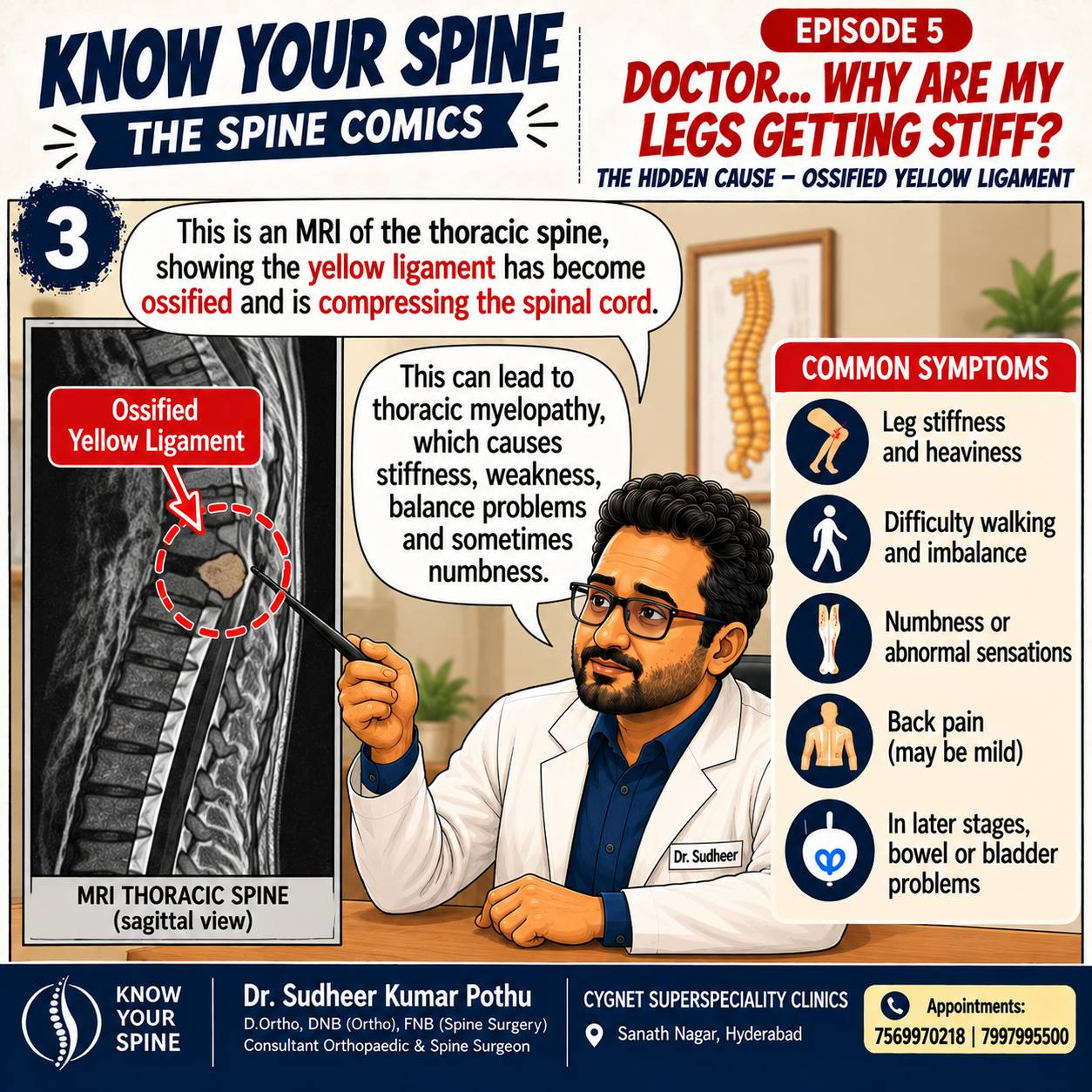
This is different from simply having back pain or a pinched nerve. A patient with thoracic myelopathy may gradually develop problems with walking, balance, leg strength, sensation and, in some cases, bladder or bowel function.
Not every spine problem is a disc problem
A disc prolapse or slipped disc is only one possible cause of spinal nerve or spinal cord compression. Other causes can include spinal canal narrowing (stenosis), ossified ligaments such as OYL/OLF, OPLL, fractures, tumours, infections and other conditions affecting the spinal canal.
Leg symptoms do not automatically mean a slipped disc. The symptoms, neurological examination and imaging findings must all fit together. This is especially important when a person has progressive difficulty walking or symptoms affecting both legs.
Symptoms of OYL that should not be ignored
- Difficulty walking: legs may feel heavy, stiff, weak or difficult to control.
- Loss of balance: walking may become slower or less steady.
- Numbness or tingling: altered sensation may affect one or both legs.
- Leg weakness: climbing stairs, rising from a chair or walking longer distances may become difficult.
- Stiffness or tightness: the legs may become abnormally stiff; doctors call this spasticity.
- Mid-back pain or stiffness: pain may occur, although severe cord compression can sometimes occur without severe back pain.
- Bladder or bowel changes: these need prompt medical assessment, particularly with new weakness or walking difficulty.
A particularly important combination is progressive walking difficulty, stiffness or weakness of both legs, numbness and poor balance. This pattern may indicate a spinal cord problem rather than only a lumbar disc problem.
Why can OYL be missed?
Disc bulges and age-related degeneration are very common on spine scans. A lumbar MRI may show a disc bulge, and it can be tempting to assume it explains every symptom. However, an abnormality on an MRI does not automatically mean it is the cause of a patient’s symptoms.
If a person has increasing stiffness in both legs, abnormal reflexes, imbalance and progressive walking difficulty, a spine specialist may need to assess the spinal cord and thoracic spine—even if a lumbar scan has already shown a disc bulge.
How is ossified yellow ligament diagnosed?
Diagnosis usually combines a detailed neurological examination with MRI and CT imaging.
MRI scan
MRI helps assess whether the spinal cord is compressed, how severe the narrowing is, which levels are affected and whether there are changes within the spinal cord.
CT scan
CT is particularly useful for showing the actual ossification or bone formation in the ligament. It can confirm the diagnosis and help plan treatment when needed.
Does everyone with OYL need surgery?
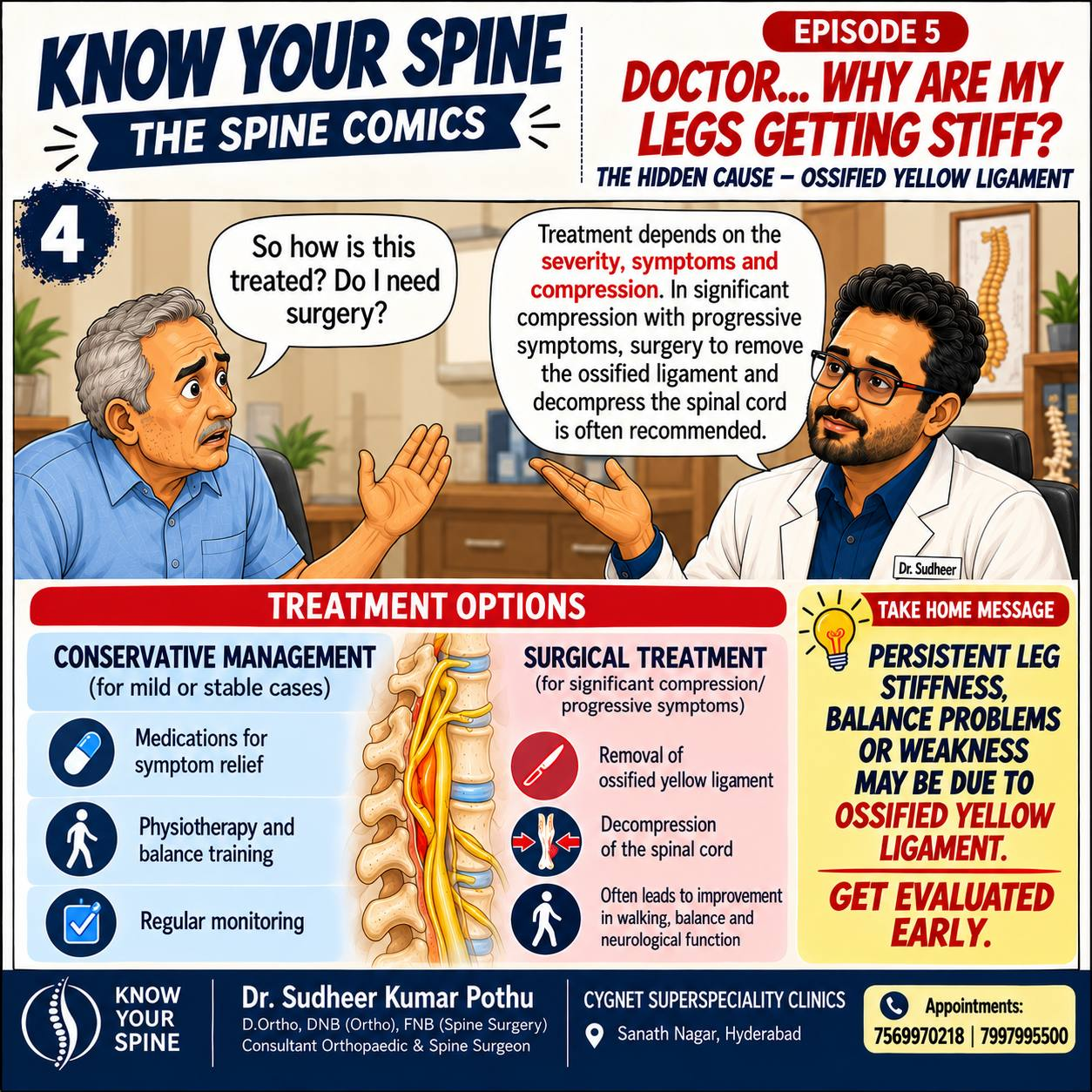
No. Finding ligament ossification incidentally on a scan does not automatically mean an operation is needed. If there is no significant spinal cord compression or neurological symptom, the condition may be observed according to the individual clinical situation.
The situation is different when OYL causes significant spinal cord compression and progressive myelopathy. Surgery may be considered for progressive walking difficulty, increasing weakness, marked leg stiffness or spasticity, worsening neurological function, significant cord compression, or bladder and bowel dysfunction.
The purpose of decompression surgery is to create adequate space for the spinal cord and help prevent further neurological deterioration. The exact treatment depends on the level and extent of compression, spinal alignment and each patient’s overall health.
Why early recognition matters
The aim is not simply to reduce back pain. The more important goal is to protect the spinal cord and preserve neurological function. Once severe spinal cord dysfunction has developed, recovery may not always be complete even after successful decompression.
Seek a spine evaluation for progressive walking difficulty, increasing leg weakness, unusual stiffness in both legs, loss of balance, frequent falls, worsening numbness, or new bladder or bowel problems.
Take-home message
Not every spine problem is a disc prolapse. Ossified Yellow Ligament (OYL/OLF) is a lesser-known but important cause of thoracic spinal cord compression and myelopathy. The key is to treat the patient and the neurological findings—not simply an MRI report showing a disc bulge.
Concerned about progressive walking difficulty or spinal cord compression?
A detailed neurological examination and appropriate spine imaging can help identify whether symptoms are arising from a disc, spinal stenosis, an ossified ligament or another spinal condition.
Dr. Sudheer Kumar Pothu
D.Ortho, DNB (Ortho), FNB (Spine Surgery)
Consultant Orthopaedic & Spine Surgeon
Cygnet Superspeciality Clinics, Sanath Nagar, Hyderabad
Appointments: 7569970218 | 7997995500
This article is for patient education and general awareness. It does not replace individual medical consultation, examination or treatment.
